
Tata Steel more than doubled its Indian capacity through acquisitions and expansion, strengthening cash generation as it pursued a costly restructuring of its European operations.

The latest results suggest Tata Steel Europe may have lost pricing power, though production and turnover are up.
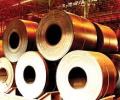
Analysts sceptical whether company will sustain rise in operating profits.
Tata Steel on Wednesday reported a 272 per cent year-on-year (Y-o-Y) jump in consolidated net profit, attributable to owners, at Rs 3,101.75 crore in the second quarter of 2025-26 (Q2FY26) led by higher sales volumes in India and planned cost takeouts across geographies.

With the worst in terms of pricing pressures behind Tata Steel, its outlook is expected to improve. Europe has seen hot rolled coil prices rise this January after the European Union's (EU's) carbon border adjustment mechanism (CBAM) kicked in and further price improvements may be on the cards once import quotas come into play in June.
There is positive sentiment for Tata Steel on the basis of strong domestic demand, a turnaround of European operations and moderate valuations. A combination of capacity expansion, efficiency gains, higher asset utilisation, and improved operating leverage may lead to margin expansions.
Tata Steel is strategically positioned for growth, leveraging India's robust steel demand, significant cost transformation programmes, and favourable protectionist policies in the EU and UK. The company is expanding its India capacity and optimising operations in its European units to enhance profitability and reduce debt.

The proposed changes in Long Products business will predominately affect management and administrative functions at sites in Scunthorpe, Teesside and Workington.
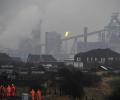
Some feel that Tata Steel has put these assets on the block only after exhausting all the options.

The European unit has a total steelmaking capacity of 18 million tonnes.

Tata Steel's consolidated net profit more than doubled to Rs 2,007.36 crore during the June quarter, on account of "increase in net steel realisations and the planned cost-takeouts" across geographies. The Tata Group entity had posted a net profit of Rs 918.57 crore in the year-ago period.

The Tata Steel Group has extended substantial financial support to the UK business and suffered asset impairment of more than 2 billion pounds in the last 5 years.
The UK steel industry is struggling for survival in the face of extremely challenging market conditions.
The steelmaker's India basket grew after Tata Steel completed its acquisition of Bhushan Steel under the Insolvency and Bankruptcy Code process and its subsidiary, Tata Sponge, acquired Usha Martin.

High costs and write-down of expensive inventory result in a loss, but analysts see demand & realisations improve.

It was August 2007. Tata Steel was turning 100. Jamshedpur, its hometown, had an air of celebration. The line-up for the special event included the launch of Air Deccan's commercial flight connecting Kolkata and Jamshedpur, and release of Russi Lala's new book, Romance of Tata Steel. There was also the screening of The Spirit of Steel, a 20-minute documentary directed by Zafar Hai showcasing Tata Steel's legacy, and a corporate anthem penned by Javed Akhtar and composed by Shankar, Ehsaan and Loy.

While write-off will push up its debt equity ratio, decline in equity will push up return ratios.

Tata Steel has a very British problem. The performance of Europe dragged the steel major's October-December (Q3FY23) performance with the UK business accounting for a major part of the operating loss; on the bottom line, the overhang of the British Steel Pension Scheme (BSPS) showed. And a nearly three-year discussion with the UK government on a support package for a green transition resulted in an offer that fell short of the ask.
It plans to lower employment costs with the estimated reduction in employee numbers, about two-thirds of which are expected to be office-based white-collar roles - a majority expected at its Netherlands unit.
The Labour government in the UK has cleared the decks for a 500 million grant to Tata Steel, paving the way for decarbonisation of the company's British business and a sustainable financial future. In a statement, Tata Steel said that it has signed a 500 million Grant Funding Agreement (GFA) with the UK government, allowing it to "proceed at pace with the project to install a state-of-the-art electric arc furnace (EAF) at the Port Talbot steelworks in Wales". This is part of the 1.25 billion green steel project in Port Talbot, of which Tata Steel's investment is to the tune of 750 million.

Indian benchmark equity indices, Sensex and Nifty, closed lower due to persistent geopolitical tensions in the Middle East and elevated crude oil prices, with investors remaining cautious ahead of fresh US sanctions on Iran.

The announcement evoked a sharp response from the UK and Ireland's largest trade union, Unite, which said it would fight for every job and demanded that there would be no compulsory redundancies from Tata Steel.

'Brexit might delay the sale process of Tata Steel's UK operations'.
'When you look at reviving private sector capex, I don't think there's a better story than steel.'
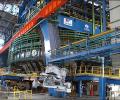
Tata Steel's June quarter profit has slowed down on higher input cost.

Tata Steel delivered one of its best financial performances ever in the third quarter of the current financial year, and surpassed its deleveraging target of $1 billion. In an interview, Koushik Chatterjee, executive director and chief financial officer, Tata Steel, tells Ishita Ayan Dutt that the company will continue to focus on deleveraging but profitable and value-added growth will be equally important.

Indian benchmark equity indices, the Sensex and Nifty, bounced back significantly, with the Sensex climbing 628 points and the Nifty snapping its seven-day losing streak, driven by easing global bond yields and fresh foreign fund inflows.

Indian benchmark indices Sensex and Nifty recorded their third consecutive day of gains, primarily driven by an over 8 per cent surge in Bajaj Finance following strong Q1 FY27 results, coupled with significant foreign fund inflows and a dip in crude oil prices.
Tata Steel's domestic operations have been its cash cow.

Indian benchmark indices Sensex and Nifty extended their losses for the fourth consecutive session, with the Sensex declining 363.66 points and the Nifty dipping 126.65 points, primarily due to a sharp jump in Brent crude oil prices to USD 98.32 per barrel amid escalating tensions in West Asia.
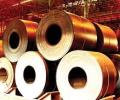
The company agrees to discussions for long-product division with Swiss group Klesch.
Tata Steel UK is reformatting its operations in Port Talbot by investing 1.25 billion in an electric arc furnace facility with the UK government contributing 500 million. The project will take around three years to complete, if all the regulatory clearances come through. The facility will use scrap and be classified as green since it will utilise renewable power and cut carbon emissions considerably.

Indian benchmark indices, Sensex and Nifty, closed higher, primarily driven by bank stocks and encouraging US inflation data, which fuelled expectations of a less aggressive Federal Reserve monetary policy. However, escalating US-Iran hostilities tempered investor sentiment, leading to some profit-taking.

Indian benchmark indices Sensex and Nifty ended a four-day rally, closing lower on Tuesday following the introduction of a new Closing Auction Session (CAS) for F&O stocks, which has added a layer of volatility and led to an early adjustment in market structure.
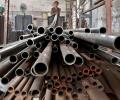
The imposition of 15 per cent export duty on steel has suddenly altered the prospects of the sector to negative and led to a big sell-off in steel stocks. Iron ore and pellet exports have to face duties of 45-50 per cent, which means they become uncompetitive. The Ukraine war has led to a supply crunch in global markets and pushed up prices, with Europe, in particular, looking for replacements for Ukrainian and Russian exports.

Indian benchmark indices, Sensex and Nifty, bounced back significantly after two days of losses, with the Sensex climbing 443.97 points to settle at 76,922.64, driven by positive global market trends and a drop in crude oil prices.

Rating agencies may downgrade the company.
Indian benchmark equity indices, Sensex and Nifty, extended their winning streak for a third consecutive day, driven by a rally in IT stocks and global cues suggesting a more accommodative monetary policy after softer-than-expected US jobs data.
Aiming to revive its loss-making long-product business in Europe, Tata Steel on Friday said it plans to invest 400 million over five years, shut or mothball parts of Scunthrope plant and slash 1,500 jobs in England.
